The Section 502 direct loan program, administered by USDA’s Rural Housing Service (RHS), provides long-term, subsidized direct loans at interest rates as low as 1 percent to rural households with incomes at or below 80 percent of the median. It is the only federal program of its kind and the most targeted homeownership mortgage product in America. By statute, 40 percent of all loans go to very low-income households with incomes at or below 50 percent of the median. The Section 502 program is among the most efficient federal housing programs. Over the last five years (FY 21-25), the average all-in cost to the federal government for a Section 502 loan was $12,600.
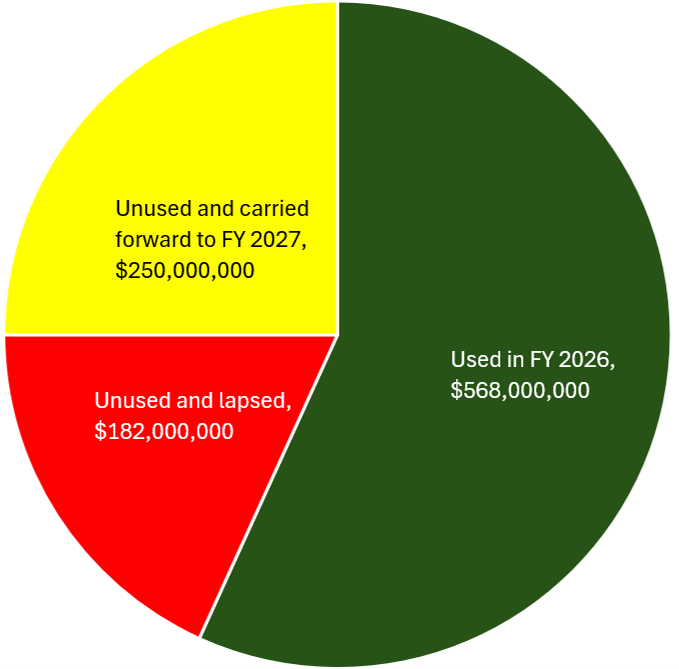
In Fiscal Year 2026, Congress appropriated $1 billion to the Section 502 program. The FY 26 appropriation allowed USDA to carry over approximately $250 million into FY 27, ensuring a smooth transition to the new fiscal year. However, the statute did not prevent or discourage USDA from using all the appropriated loan funds in FY 26.
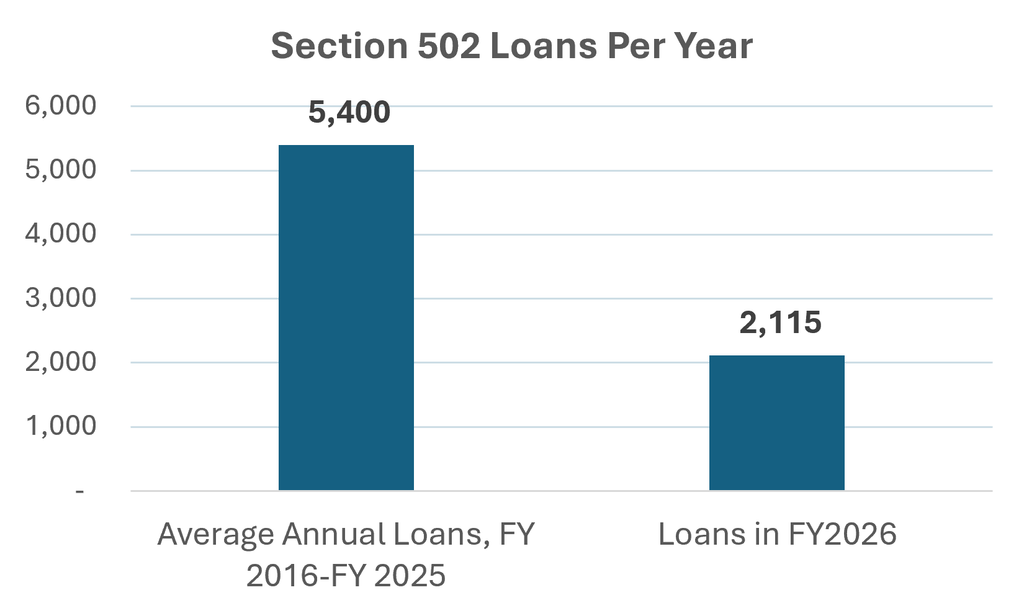
For the ten fiscal years before FY 26, USDA averaged $1.01 billion across more than 5,400 Section 502 loans and spent every dime Congress appropriated. In FY 26, USDA obligated only $568 million for 2,115 Section 502 loans, an astonishingly poor performance compared with previous years, especially given recent White House data on poor housing conditions in rural America. While $250 million will carry over, $182 million has lapsed, constituting an impoundment and a violation of the Impoundment Control Act of 1974.
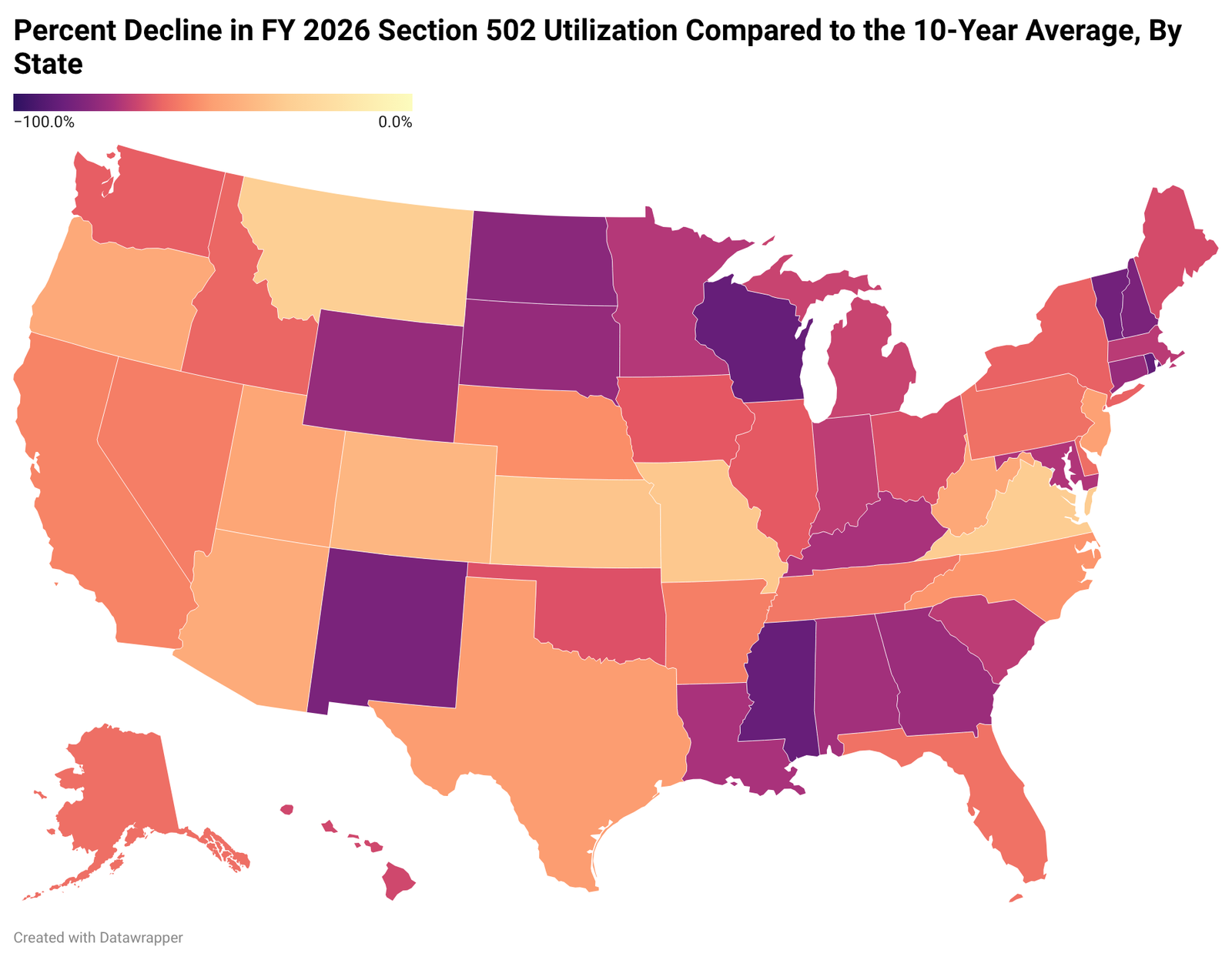
The visual below shows the decline in utilization by state in FY 2026 (compared to the ten year average from 2016-2025).
This dismal performance stems from the revision to the Section 502 handbook issued on February 10, 2026. It also reflects the lackadaisical manner in which USDA/RHS administered the program. Between the enactment of the FY 26 Agriculture Appropriations bill on November 11, 2025, and the handbook’s issuance, USDA made almost no Section 502 loans, even though a waiting list of qualified applicants existed. In addition, USDA allowed families to continue applying for loans without informing them that the program was about to undergo a substantial revision.
Revisions to the Section 502 Handbook
In the past, RHS has used the Section 502 handbook to guide field staff in administering the Section 502 program. Before this year, it had never been used to make or change policy. RHS made these revisions without consulting Congress or following a rulemaking process.
Click here for the February 10 revisions.
There are three key revisions in the handbook:
- The maximum loan limit for Section 502 loans was arbitrarily reduced from 80 to 60 of area loan limits. Of the 3,143 counties with at least one community eligible for Section 502, at least 804, or 26 percent, will be affected by this change. This change reduced the loan limit by at least $95,000 in every rural county.
- An arbitrary increase in bureaucracy: Rural Development State Directors are required to conduct at least two separate reviews of each Section 502 loan application, one for applicant eligibility and the other for final loan approval.
- The revisions reduce support for rural families seeking access to the Section 502 direct loan program. The revisions arbitrarily cut the fees nonprofit organizations may charge to initiate, support, and package Section 502 direct loan applications from $1,750-$2,000 to $750.
USDA/RHS argued that these changes were necessary to reduce Section 502 loan levels. In FY 25, Section 502 loans averaged $272,279; in FY 26, the average was $268,557, a reduction of only 1.3 percent.
The two review requirements for state directors, political appointees who may lack real estate or affordable housing experience, have confused and slowed loan processing. The dramatic reduction in packaging assistance, a first-Trump-administration initiative, has caused some nonprofit organizations to leave the program, making it even harder for rural families to navigate the USDA loan application system.
USDA has made much of the delinquency rate on Section 502 loans. This contention ignores the fact that the Section 502 portfolio’s overall performance remains strong. According to the Technical Supplement to the FY 2026 Budget – Credit Supplement – OMB, the default rate on Section 502 direct loans, net of recoveries, is 4.01 percent. (This calculation considers the default rate on loans and the recovery rate, which is the amount recovered after default and the actual cost to the government.) This compares to the rate for Section 502 guaranteed loans of 2.7 percent.[1]
This information matters because the direct and guaranteed programs serve different income groups. The direct loan program is limited to borrowers with incomes not exceeding 80 percent of the median, and 40 percent of direct loan funds are reserved by statute for very low-income borrowers with incomes not exceeding 50 percent of the median. The average annual income For a direct-loan borrower, it is $29,000. The guaranteed program serves a much higher-income population (up to 125 percent of the median). The average annual income for a guaranteed loan borrower is $54,000. Although it serves lower-income borrowers, the direct loan program is nearly as efficient as the guaranteed program.
[1] “Office of Management and Budget Credit Supplement Technical Supplement.” Credit Supplement, www.whitehouse.gov/wp-content/uploads/2025/04/BUDGET-2026-CREDIT.pdf. Accessed 17 Mar. 2026.